Drawing along with the TV
A kid, a box of crayons, and Commander Mark on PBS.
Ask Justin Weinmann what he does and he says he's a jack of all trades. Then he turns it around: what doesn't he do? Websites, graphic design, photography, painting, game design, video, and drawing on plain paper.
It started in front of a television. Whenever Mark Kistler came on PBS, young Justin sat on the floor with paper and crayons and drew everything Kistler drew. “Without him I would definitely not be drawing still at my age,” he says.
The first thing he remembers being proud of was a tree he drew at about five, which his mom thought had amazing detail. By second grade he was in the city newspaper for a paper airplane he'd built.
He has tried on the labels. He used to say artist. Then creator. Now, he says, he's just himself.
“I just think I'm me, and I don't know how to be anything else.”
What makes this pop?
Comic books taught him detail. Color taught him to finish.
After Mark Kistler came comic books. Superman and Spider-Man were his favorites as a kid, and the first comic he ever owned was an X-Men issue he got in elementary school.
Through his teens and early twenties he built a comic character of his own. The stories are still in his head, but the project never got pinned down. “It's adrift with all my other projects for another time.”
What comics really taught him is that detail doesn't have to mean realism. “I love realism. I also love stylized art. They taught me to embrace what the moment calls for, that I don't have to have a signature style. I can do whatever I want.”
He still draws the heroes. The Justice League set was a commission, and Green Lantern is his favorite of the four. “The green just pulls me in. He's the only one that naturally has a glow about him.”
Then there is Captain America, the piece that explains him. He drew it to hang in his classroom while he was teaching American history. Today it hangs in his son's room. He got every detail in with Bic, then added spot color in India ink so it would stand out.
He works on smooth Bristol, which takes ink beautifully and fights anything wet. “That challenge makes it fun for me.”
“What will make this pop?”Asked of every piece
He doesn't always get the answer right. “All the time. For every finished piece I keep, I probably have ten or more in the trash bin. We become the creators we are by failing. Without it, we are nothing.”
The heroes come with a built-in fan base. His originals don't. “Each piece of original art has to sell itself to a new group of people each time. It lives and dies on its own merit.”
His biggest influence is still Mark Kistler, followed by the comic artists he grew up on. After that, he says, the list is too long to name. “If you've been online for a while and draw with ink or watercolor, you're probably one of my heroes.”
Letting it go
Why the history videos stopped.

He taught history for years, and History Illustrated grew out of it: a hand-drawn history channel. What is he proudest of? Knowing he helped people around the world understand social studies a little better on the day they watched one of his videos.
He tried to bring it back again and again, “because it's hard to put down something you love.” But how people learn is changing, and he sees room for new people with new ideas to take the next step. He's happy to let them have at it while he moves on to his other passions.
Nothing has gone away, though. Every video, lesson and classroom material he made is still online at historyillustrated.com, free for anyone who needs it. The channel itself now carries the devlog for his card game, HI Impact.
“Something you create may reach more people than you ever intended.”
The lesson he's carrying forward: “That's a powerful thing, so make sure the things you create provide value to others in a positive way.”
Why he put the screen down
A human who makes things for humans.
When he first got on Twitter, he somehow found an audience that wanted more than prints. People bought his originals straight from his own site, asked how he made them, and he loved that they were in awe. Then, almost overnight, everything he made got waved off as AI.
So his own art went back to paper. He still uses a computer for layouts, graphics, websites and his card game, but the drawings he makes for himself are ink. He wants people to know a person made it.
“I'm a human that makes things for humans.”
Ink takes him back to being a teenager alone at his desk, dreaming things up, and to doodling in the margins in class. What he loves about it is “the ability to mess up and keep going.”
Drawing in ink, he says, is anxiety giving way to relief. That's why he built his newest project on it. Ink Method grew out of the story-prompt dice he used to roll as a warm-up. A prompt beats creative block because it gets you started, and starting is what breaks you out.
Each week's sheet is filmed from above with no talking, just pen sounds and slow drawing, and cut into short videos that end on the prompt code so anyone can draw the same one.
The hardest prompts mash together things that don't belong. “You have to stretch your mind to figure that out,” he says. Those are often the pieces he's proudest of.
He doesn't measure it by how many people join in. Success, he says, means finding the thing that gets him back into drawing traditionally.
Ridiculous history, one card at a time
A game built on high school Magic and a lifelong love of icons.

Card game · 200+ cards · in development
Three champions, one historical event, and gear that ends up on the wrong people. He documents the build in time-lapses of himself painting the characters.
Watch the devlog →In high school it was Magic: The Gathering: playing with friends, the strategy, and the fact that every card had art commissioned from a different artist. He wanted to paint for Magic someday.
HI Impact is what came out of that. He built it to be faster, with no individual decks to build. Each player gets three champions who have to survive a historical event. Every other card is equipment, an action or an amendment that can help a champion get through it, or help them lose.
The comedy comes from the gear. Equipment designed for one historical figure can end up on someone else entirely, so the game turns into the kind of ridiculous history he loves.
“Convey an entire meaning or message in a simple symbol.”On designing icons
The graphic design is the part he loves most. He built websites in the 1990s and 2000s, decided he could make better icons than the ones he was given, and never stopped. The hardest part so far is scale: drawing more than 200 cards.
Those cards are the one place he's sticking with digital. He planned the game that way from the start, and the characters have to match the look of the interface he has already built.
The desk
A mess. Always a mess.
“If I'm at a desk, a pen isn't too far, and neither is paper. If the three of us find each other, a doodle masterpiece is in the making.”
1 Fineliners 2 The palette 3 Van Gogh watercolors 4 Brushes 5 Triptych: three 11 × 14 sheets, side by side
At the desk
- WhereAnywhere. He draws wherever he can.
- WhenAny time he can. “I'm a father with too many places to be.” He makes things at home and on the go.
- SoundtrackNone. He draws in silence. “It's my therapy.”
- Projects goingToo many to count, with three or four always at the front of his mind.
- What bugs him mostHis book, still unfinished after all these years. The Maschenkel keeps getting in the way.
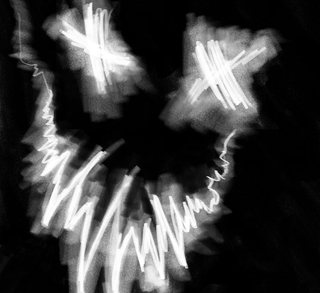
The monster that keeps him from finishing
A book about unfinished work, still unfinished.
The Maschenkel, he explains, is “the thing that lives within me and makes sure that my creativity keeps moving to the next thing instead of finishing any one.”
His book, Don't Let Him Finish It, is built around that creature. Some of the poems in it are 25 years old. Why bring them back now? “Some things were not meant to stay buried.”
“I can't seem to finish a book that is about unfinishedness. He won't let me.”
What has kept him from finishing? “The Maschenkel, probably. I try and try but can't figure out why. Have I ever finished anything?”
So who is the book for? “Me. But if you mean who should read it: you. Everyone. Maybe it can explain who I am to others, and maybe who you are.”